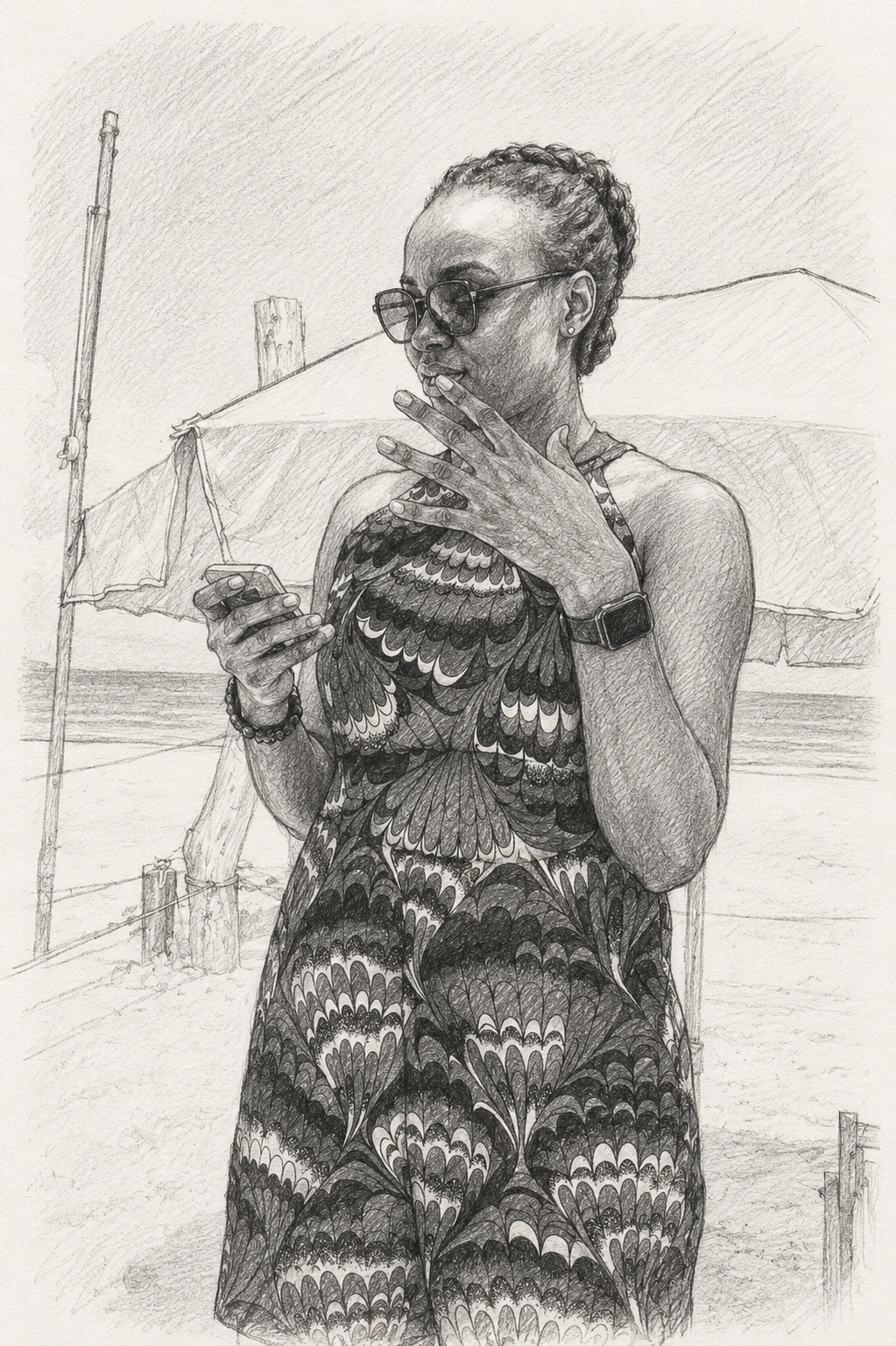
The Imam’s voice pierced the speakers, slicing through the morning quiet like a hot knife through butter. Without checking the time, I knew it was 5 a.m. The unmistakable call to prayer had become my unofficial alarm clock. One of the “perks” of living next to a mosque was that you did not need an alarm. It was loud, unrelenting, and impossible to ignore.
I groaned, sighing heavily as I tossed the duvet aside, exposing my thick, ivory thighs to the cool morning air. The wake-up call always left me irritated, my mood souring before the day even began.
“I hate this place,” I muttered under my breath, hissing in frustration. My hand fumbled along the floor until it found my phone, the faint glow cutting through the dim room. As I unlocked it, a message from Kalu popped up.
Roses are red
Violets are blue
I’m in love with an Igbo girl, you!
I hissed again, louder this time, rolling my eyes at the cheesy rhyme. With a flick of my wrist, I flung the phone onto the bed. It landed against Uju, who mumbled something incoherent in her sleep and shifted slightly, pulling the covers tighter around her.
The absurdity of it all- being woken by the Imam, Kalu’s corny text, and the suffocating monotony of my life here swirled in my head. I stared at the ceiling, knowing it would take more than a few minutes to calm my frayed nerves and start the day.
“Ujay, wake up!” I whispered, tapping her shoulder gently.
“Uju!” I called out again, scrolling through my playlist, searching for the perfect early-morning jam. It was a big day, and my second interview with White Waters. I needed all the motivation I could muster to shake off my grogginess and face it head-on.
Uju stirred, turning her head towards me with a sleepy groan. “Ain’t you going to work?” I asked, squinting at her dishevelled face.
“No, I’m off today,” she mumbled, her voice muffled as she immediately pulled the blanket over her head and retreated into her cocoon.
“Girl, I envy you right now,” I muttered, shaking my head as I clicked on Kierra Sheard’s Desire, keeping the volume low enough not to disturb her more. Uju’s work schedule gave her one blissful day off each week, a luxury I hadn’t tasted in months with my endless job hunt.
The Imam’s voice boomed through the speakers again, slicing through the dawn with renewed vigour. I rolled my eyes and exhaled. It always amazed me how Nigerians had adapted to living with religious centres practically embedded in residential areas. The cacophony of prayers, chants, and sermons was just one of the quirks we were expected to endure. It had been barely a week since I arrived in Lagos, and I still wasn’t used to it.
I flashed back to my first morning in this chaotic city, when I’d marched straight to Ìyál’ọ́jà: Ujay’s supposed cheerful, chubby Alhaja neighbour to vent about the noise. My irritation had boiled over as I described the incessant early morning cries from the mosque speakers and how they disrupted my beauty sleep.
“Believe me,” Uju had said, her face lighting up with amusement, “Lagosians are actually grateful for the mosques. This natural alarm system comes in handy with the way we sleep!”
“This is crazy,” I’d retorted, shaking my head in disbelief.
“Well, there’s one person you could talk to if you really want to complain. We call her Ìyál’ọ́jà. She lives here,” Uju had chimed in, pointing at the small bungalow tucked into the heart of our noisy neighbourhood.
I marched down to Ìyál’ọ́jà’s house like a dissatisfied client heading straight to the customer service desk, my irritation fueling each step.
“Good morning, Ma,” I greeted, spotting a chubby woman seated regally on the verandah like a village chief presiding over her subjects. The way she barked orders at people scurrying in and out of the house, I knew she was Ìyál’ọ́jà.
She gave me a dismissive once-over before acknowledging me.
“…Where do you say you are from?” she asked, narrowing her eyes.
“I’m from Imo State,” I replied, my voice steady but polite.
“That Imo you come from, they don’t teach you people manners?” she fired back, her voice rising like a thunderclap. “I should tell Alfa to stop morning prayers, abi kini o nso?” She frowned deeply, her voice sharp enough to cut through the morning air.
“That’s not what I said,” I tried to interject, holding my hands up in a gesture of peace.
“Gbenu oshi soun!” she yelled, shutting me down completely. Her words spilt out in a torrent of rapid Yoruba, and though I didn’t understand the specifics, the tone made it abundantly clear she wasn’t singing my praises. She wagged a thick, accusatory finger at me, and I half-expected her to summon the strength to rise and deliver a resounding slap.
People began to gather around her, their murmured “ki lode?” filling the air as they tried to piece together the drama. I realised it was my cue to exit. Red-faced and feeling thoroughly humiliated, I sneaked away, retracing my steps back to our room. Her ranting followed me like a soundtrack of shame, echoing in my ears long after I’d closed the door behind me.
I flopped onto the bed, wishing Ujay was home to interpret the barrage of Yoruba being flung my way. For the next two weeks, I learnt the art of accepting what I couldn’t change. So, when Mummy Tope threw me a cold “pele” after her son dipped his grubby hands into my carefully preserved bucket of water, I smiled, counted to ten, and let it slide. I’ve learned that some battles aren’t worth fighting.
“Akudo, isn’t today the interview?” Uju asked, her voice cutting through the early morning haze.
“Yes,” I replied, suppressing a sigh.
“And you’re still here? Why haven’t you taken your bath? At least book a space. If you don’t leave before 6 a.m., you won’t get to Ikate on time,” she said, adjusting her blanket with the expertise of someone who had mastered life in this Lagos madhouse.
I sighed louder this time. The second thing I hated about Uju’s neighborhood, apart from the mosque’s “natural alarm,” was the communal toilet and bathroom we shared with 23 other occupants. Uju had tried to soften the blow by introducing a “night bucket” with a lid for midnight emergencies, but to me, it was the absolute worst.
Adaku, when I first told her I’d moved to Lagos, had sent an excited message: “Ah! You’re enjoying o!” I wanted to respond with a photo of myself in a queue, waiting for my turn to use the toilet while two others brushed their teeth at the entrance, next to the general kitchen. Sometimes, I wish people would ease up on their Lagos hype. It sets expectations so high, they’re almost impossible to meet.
Resigned, I fetched cold water from the drum since it was too late to boil any, and made my way to the bathroom, towel in hand.
“Akudo, good morning,” a familiar voice said.
It was Taju, the guy next door, whose breath could rival a garbage dump on a hot day. Every time he opened his mouth, it felt like a rat had died in there and left its ghost behind. His deep baritone voice was unmistakable.
“Good morning, Taju,” I replied curtly, not slowing my pace.
“Hope you slept well,” he added, shuffling toward me with a towel precariously wrapped around his bony waist. Even in the dim light, his scrawny frame and skeletal hands were impossible to miss.
“I did. Hope you’re good?”
“I thank God,” he said, grinning. “Er, I hope you are enjoying Eko?”
I forced a tight smile, resisting the urge to roll my eyes. Enjoy? In this crowded, chaotic, and endlessly dirty city? Two weeks in Lagos had shown me that adulthood tastes like unripe pawpaw – bitter and regretful.
“We thank God,” I muttered, quickening my pace, but Taju kept chuckling behind me.
I started avoiding him after Uju let slip that his interest in me was more than a neighborly acquaintance. Apparently, Taju had confided in her about his feelings for me.
“Don’t be like this, Akudo,” Uju teased one evening. “TJ is a nice guy if you get to know him.”
“And I don’t want to, and I won’t,” I replied flatly.
“Why?”
I rolled my eyes and continued typing furiously on my laptop, ignoring her. Honestly, I didn’t care to explain. Living in a human-sized rat hole was bad enough; I had no plans to complicate my misery by getting emotionally involved with anyone else stuck in it.
My bath was as quick as usual, and as I was stepping out, I felt like Naaman after just three dips. Something about bathing in Uju’s bathroom makes you feel neither clean nor unclean, just… done. The architect who designed it must have envisioned toddlers as the primary users because adults were forced to crouch like contortionists just to fit. The floor tiles are so smooth and slippery, every step feels like a gamble, and the stained walls, decorated with patches of algae, offer no comfort. As for the cockroaches, they have claimed the cracks and crevices as their ancestral home and made their presence known in droves.
“Hurry o! It’s almost 6 a.m.,” Uju called out as I walked back into the room. She was up and had already tidied the small space, the kind of efficiency that Lagos life forced on its inhabitants.
“I thought today was for sleep? Why are you up so early?”
“I couldn’t sleep. Blame it on Lagos.”
“Chineke nna! May I never understand.”
“See this one,” she said, bursting into laughter. “Don’t worry. Let this White Waters job click. I give you one month, body go tell you.”
“Abeg, shift,” I muttered, nudging her aside to pick up my black shoes.
“Ehen, even if you decide to use a headphone, be vigilant, abeg. Lagos can be crazy.”
“Yes, Ma.”
“Take,” Uju said, slipping two notes into my pocket. “I know you’re still trying to settle down. This should help a little.”
“Thank you,” I said, hugging her. The alarm on her phone buzzed.
“That’s your 6 a.m. reminder,” she said, smiling.
With my handbag in hand, we headed for the door.
“I really hope I get this job.”
“I have a good feeling you will,” Uju replied, clasping my hands like a supportive older sister.
At the front of the compound, Uju began greeting everyone in fluent Yoruba, her voice animated as she switched between phrases and gestures. I couldn’t help but marvel at how quickly she’d adapted. Just a year ago, we were both in Owerri, and she could barely string two Yoruba words together. I waved at the familiar faces but deliberately avoided Ìyál’ọ́jà, who had just stepped out of her room. I wasn’t ready for another episode of her theatrics so early in the day.
I approached the wooden plank meant to bridge the open drainage in front of the compound, and I hesitated. It was a lean piece of wood, weathered and unreliable. The kind of thing Lagosians trusted without question, but I had doubts. As I stepped onto it, I felt it shift beneath my weight. Before I could retrace my steps, the plank snapped, and I plunged into the festering mix of urine, faeces, and all the unimaginable waste that Odunsi Street emptied into its gutter.
I sat there, stunned and dripping with filth, marinated in the very essence of Lagos.
All I could think was: I want to return to Owerri and forget I ever came to this forsaken city.


Leave a Reply